
If you have been searching for a Qatar freelance visa, you have probably noticed something confusing: Qatar has never issued a document that literally says “Freelance Visa” on it. What exists instead is a set of official residency pathways that let independent professionals live and work legally without a traditional employer holding their contract. In 2026, the government has tightened how these pathways are monitored, and understanding the difference between the legal route and the risky one can save you from fines, deportation, or losing months of income.
This guide breaks down exactly how the Qatar freelance visa system actually works right now, what the Mustaqel program requires, what it costs, and which shortcuts you should avoid entirely.
What People Mean When They Say “Qatar Freelance Visa”
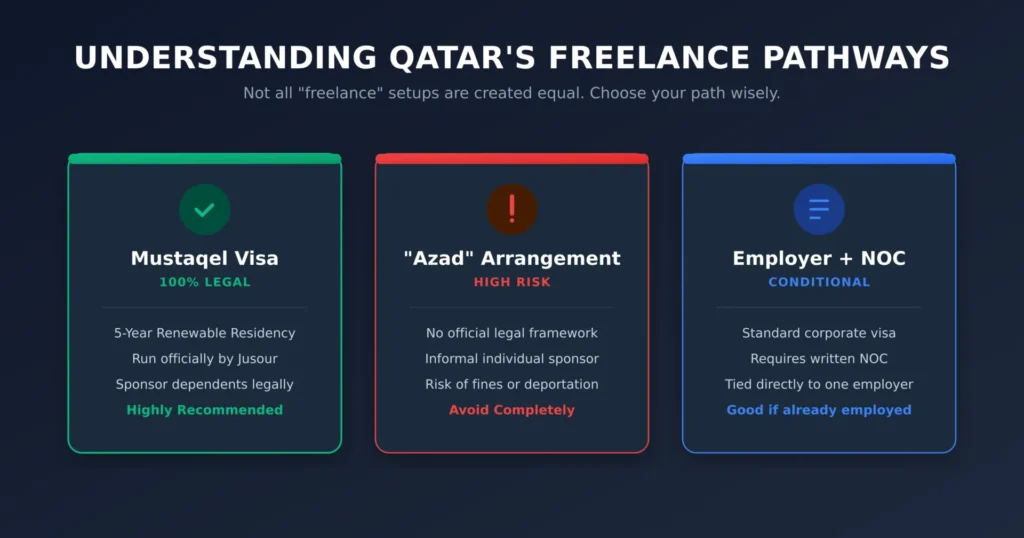
There is no standalone visa category called “freelance” in Qatar’s Ministry of Interior or Ministry of Labour systems. When professionals talk about a Qatar freelance visa, they are usually referring to one of three arrangements:
- Mustaqel Visa: a genuine five-year renewable residency permit, run by Jusour (Qatar Manpower Solutions Co.), a company wholly owned by the Qatari government. This is the only pathway with an actual official framework behind it.
- “Azad Visa” arrangements: an informal term used on the ground for a private individual privately taking on someone as a sponsor for a fee. This has no legal recognition under Qatari labour law and should not be treated as a real alternative to Mustaqel.
- Employer-sponsored work visa with NOC: a standard work visa where the holder gets written permission from their sponsor to take on outside freelance projects.
The Mustaqel pathway is the one that matters if you actually want to build a stable freelance career in Qatar. Jusour splits it into two tracks: the Entrepreneur Visa, for people with a Qatar-based business plan endorsed by a recognised incubator, and the Talent Visa, for skilled individuals in fields like arts, entertainment, sports, and technology who secure an endorsement from a relevant Qatari authority.
Who Actually Qualifies
The Mustaqel program is not open to everyone. It was built for professionals who can show verifiable skills, an endorsement, and financial capacity not for anyone simply looking for a foothold in the country. Typical eligible fields under the Talent Visa track include:
- Information and communication technology
- Arts, entertainment, and media production
- Sports
- A defined list of other specialist fields recognised by endorsing authorities
For the Talent Visa, applicants generally need a confirmed job offer or documented proof of financial self-sufficiency; a minimum bank balance of QAR 36,500 is the commonly cited threshold along with a clean police clearance certificate and endorsement from the relevant Qatari authority in their field. Entrepreneur Visa applicants instead need their business plan approved by a Qatar-based incubator before applying.
Core Policy Breakdown: What Changed in the 2026 Framework
The 2026 update to the Qatar freelance visa process centers on three things: verified sponsorship, digital tracking, and stricter documentation standards.
Sponsorship runs through Jusour, not a private individual: Under Mustaqel, your application and endorsement are processed through Jusour and the relevant endorsing authority for your field, not a Qatari citizen agreeing informally to hold your paperwork. This is the core difference from any “Azad” style arrangement, where an individual signs on as sponsor without any government platform or endorsement behind the deal.
Endorsement comes before the application, not after: Talent Visa applicants need sign-off from a recognised government authority or industry body in their field, and Entrepreneur Visa applicants need their business plan approved by a Qatar-based incubator, before Jusour will process the file.
Documentation and attestation standards apply throughout: Educational certificates, professional portfolios, and experience letters generally need to be attested, and incomplete files typically stall rather than move forward automatically.
Always confirm current fee schedules, endorsement lists, and processing steps directly on Jusour’s official Mustaqel application platform or the MOI portal before applying, since program details have been refined since the initial 2024 launch and can be updated again. Independent coverage from EY’s tax and immigration alert on the Mustaqel launch, Doha News’ breakdown of the two visa categories, and Time Out Doha’s overview of the program are also useful cross-checks if you want a second source before budgeting or starting your application.
If you are coming from an existing tourist or visit permit and considering how to shift into a working arrangement, it’s worth reading through the process for how to convert a Qatar tourist visa into a work visa before assuming Mustaqel is your only option for many professionals, a standard sponsored route is faster.
Qatar Freelance Visa: Requirements Checklist
- Valid passport with at least six months of remaining validity
- Attested educational certificates or professional portfolio
- Endorsement code from a recognised Qatari authority (Talent Visa) or an approved business incubator (Entrepreneur Visa)
- Police clearance / good conduct certificate
- Proof of financial self-sufficiency (commonly cited minimum: QAR 36,500) or a confirmed job offer
- Medical fitness report (completed after arrival, as part of residency processing)
- Application submitted through Jusour’s Mustaqel platform
- Biometric enrollment appointment, usually booked through your nearest visa processing center
Applicants coming through South Asian processing hubs should also confirm their Qatar Visa Center appointment slot early, since biometric and medical screening backlogs can add several weeks to an otherwise straightforward file.
Summary Table: Freelance Pathways Compared
Fee figures reflect the amounts reported at Mustaqel’s 2024 launch. Government fees can be revised, so confirm the current schedule on Jusour’s official Mustaqel platform before budgeting.
Step-by-Step: How the Application Actually Works
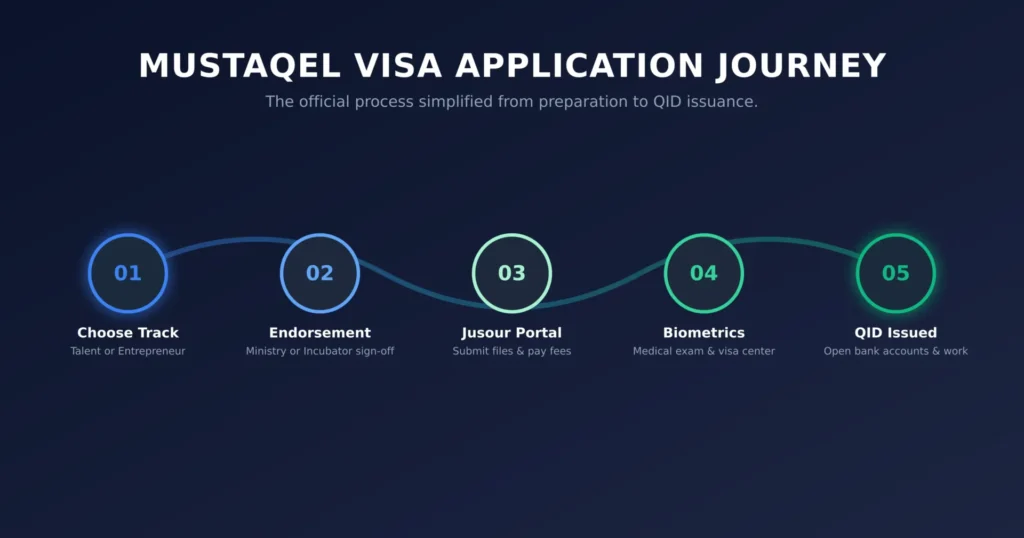
- Confirm which track fits you Entrepreneur Visa or Talent Visa and gather every certificate, portfolio sample, and experience letter you have, attesting anything issued outside Qatar.
- Secure your endorsement first. Talent applicants need sign-off from a recognised Qatari authority in their field; Entrepreneur applicants need incubator approval for their business plan. Without this, Jusour will not proceed.
- Submit your application through Jusour’s official Mustaqel platform, pay the applicable government fee, and wait for electronic pre-approval.
- Book your visa center appointment for biometric enrollment and initial document verification.
- Complete your medical examination once you arrive this converts your entry permit toward a full residence permit.
- Receive your Qatar ID (QID) and use it to open a bank account, track ongoing applications, and confirm your legal working status.
- Track your progress anytime through the Qatar visa status check tool using your passport or application number.
Cost: What You Should Actually Budget For
The government administrative fee for Mustaqel has been reported at QAR 4,000 for the Talent Visa and QAR 5,000 for the Entrepreneur Visa, on top of which applicants should budget separately for medical testing and biometric enrollment. One detail worth knowing upfront: this fee is refundable if your application is rejected, minus any administrative costs already incurred so a rejection doesn’t mean losing the full amount. Because these figures were set at launch and government fees can be revised, always confirm the current schedule on Jusour’s Mustaqel platform rather than relying on a fixed number from any single source including this one. Property Finder’s guide to Mustaqel visa fees also documents the same fee split by category if you’d like a second reference point. For a broader breakdown of standard government charges across other visa categories, the Qatar visa price guide is a useful reference point before you commit to any quote from a facilitator.
Where People Get Scammed And How to Avoid It
The single biggest risk with any Qatar freelance visa search is running into someone offering an informal “Azad” arrangement dressed up as an easy shortcut. Warning signs include:
- A sponsor asking for full payment upfront with no written contract
- Promises of guaranteed approval “without documents”
- No visa center appointment or biometric step mentioned at all
- Refusal to provide a sponsor license number you can verify
Before paying anyone or accepting a visa document, it’s worth learning how to check whether a Qatar visa is original or fake, since fraudulent freelance arrangements often surface exactly this way, a visa number that either doesn’t exist in the MOI system or belongs to someone else entirely. For a deeper breakdown of exactly how these “free visa” scams operate and what Qatari labour law says about them, see our full guide on the Qatar free visa reality and official process.
Freelance Visa vs. Standard Work Visa
Many applicants default to freelance sponsorship without checking whether a standard route fits better. If you already have a job offer from a Qatari company, a conventional Qatar work visa is usually faster to process, cheaper, and carries none of the sponsorship ambiguity that comes with freelance arrangements. Mustaqel makes more sense specifically when you plan to serve multiple clients rather than one employer.
Long-Term Outlook
For freelancers who build a stable income and residency history under Mustaqel, Qatar does offer further pathways toward longer-term status. If your goal extends beyond a few project cycles, it’s worth reviewing the benefits of Qatar permanent residency to see what qualifies and how freelance income history factors into eligibility.
Frequently Asked Questions
How can I get a Qatar freelance visa?
You apply through the Mustaqel pathway via Jusour, securing an endorsement first (from a Qatari authority for the Talent Visa, or an incubator for the Entrepreneur Visa), then submit attested documents and complete biometric enrollment and a medical exam after arrival to convert your entry permit into a five-year residence permit.
Can I work independently in Qatar without a company sponsor?
Only through Mustaqel or an NOC from your existing employer. Any arrangement outside these two official routes regardless of how it’s marketed to you falls outside what Qatari labour law permits.
How much is a freelance visa in Qatar?
The government fee reported at launch was QAR 4,000 for the Talent Visa and QAR 5,000 for the Entrepreneur Visa, plus separate medical and biometric costs. Confirm the current fee directly on Jusour’s platform, since figures quoted by any third-party source including this guide can go out of date.
What is the salary of a freelancer in Qatar?
Earnings depend entirely on field and client base rather than a fixed government salary, since freelancers bill clients directly. IT, consulting, and design professionals working with multiple Qatari or international clients typically report the highest and most consistent freelance income in the current market.
How long does the freelance visa process take?
Timelines depend on how quickly your endorsement comes through and how busy your local visa center is for biometric and medical appointments. Getting attested documents right the first time and booking your appointment early are the two biggest factors within your control check Jusour’s platform for current expected processing windows rather than relying on a fixed estimate.
Can I switch from a tourist visa to a freelance visa while inside Qatar?
It depends on your nationality and current permit type. Some applicants can transition status without leaving the country, while others need to exit and re-enter under the new permit check current conversion rules before assuming either path applies to you.
Note: Mustaqel Visa fees, endorsement requirements, and processing details are based on the program’s publicly reported framework, including coverage from Jusour’s official platform, EY’s immigration alert, and Doha News and may be updated by Jusour or the Ministry of Interior. Verify current requirements on Jusour’s official Mustaqel platform or the MOI portal before applying or making payment to any sponsor.