
Every job in Qatar, from a construction site in Lusail to an office in West Bay, runs through one authority behind the scenes: the Ministry of Labour Qatar. Most residents only think about it when something goes wrong, a delayed salary, a stuck work permit, or a dispute with an employer, and by then it’s already stressful trying to figure out which portal to use or who to call.
This guide covers exactly what the Ministry of Labour Qatar handles in 2026, how to use its digital services without visiting an office, and, if a complaint ever needs to go all the way to court, what that entire path actually looks like.
What the Ministry of Labour Qatar Actually Handles
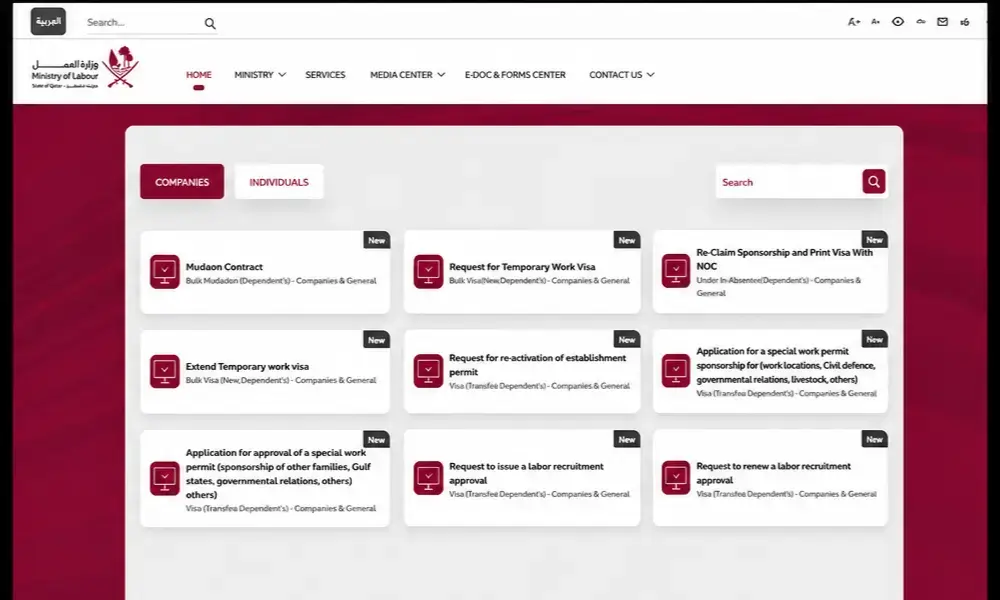
The Ministry of Labour Qatar (MOL) is a separate authority from the Ministry of Interior. Where MOI controls your visa, residency, and entry status, MOL governs the employment relationship itself: your contract, your salary, and your rights as a worker. If you’re still sorting out entry paperwork rather than an active job, that side of the process is covered separately in our guide on how to apply for a Qatar visa online.
Under Labour Law No. 14 of 2004 and its later amendments, the Ministry of Labour Qatar is responsible for:
- Employment contract attestation and renewal, confirming a signed contract is legally registered
- Work permit issuance, renewal, and cancellation
- Labour recruitment approvals for companies hiring from abroad
- The Wage Protection System (WPS), which monitors whether salaries are actually paid on time
- Labour inspections covering safety, working hours, and living conditions
- Dispute resolution, from informal mediation up to the Labour Court
If you already have a job offer and are trying to understand the residency side rather than the labour side, our Qatar Work Visa guide walks through the sponsorship and entry steps separately, since the two processes run in parallel through different systems.
MOL’s Digital Services: Portal, Login & the Amerni App
As of 2026, nearly everything the Ministry of Labour Qatar offers can be completed online, no branch visit required for most transactions.
Two main channels exist:
- The Individuals Portal, for workers checking their own contract, filing complaints, or requesting an employer change
- The Establishments Portal, for registered companies managing recruitment approvals, contract attestation, and WPS filings
Logging in to either uses the National Authentication System (NAS), the same single sign-on used across most Qatari government platforms. You’ll need your Qatar ID (QID) number and a registered mobile number to receive a one-time password (OTP), there’s no separate MOL account to create from scratch.
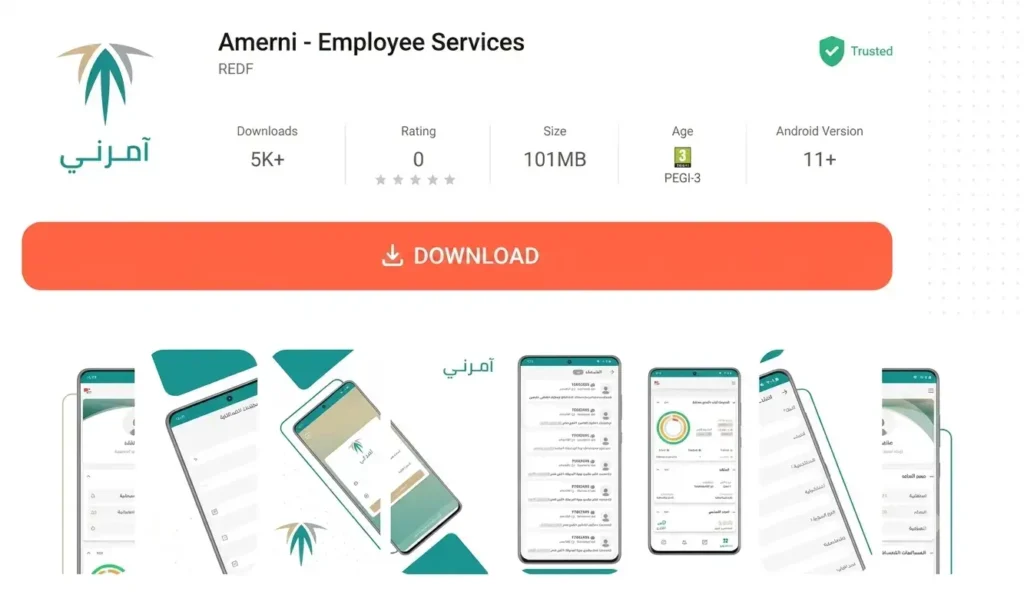
For a phone-first alternative, the Amerni app (Google Play and the Apple App Store) mirrors most Individuals Portal functions, including complaint submission and status tracking. Employers and recruits can also use the 92727 SMS service to check recruitment approval status or schedule interviews without logging in at all.
If your question is specifically about switching employers, the Employer Change Service now runs entirely through these two portals, and the No-Objection Certificate requirement has been abolished. Once your new contract is verified and the legally required notice period is observed, the update is automatically forwarded to the Ministry of Interior to adjust your residency status, so you won’t need to separately update your MOI Qatar visa check records once that step completes.
How to Check Your Labour Contract Online
Your labour contract, not just your visa, is what legally defines your salary, working hours, and job title in Qatar, and it’s worth verifying it matches what you actually agreed to before any dispute arises.
- Log in to the MOL Individuals Portal through NAS (QID + OTP), or open the Amerni app
- Go to the Labour Contract Verification section
- Enter your QID or the passport number tied to your application
- Review the listed position, salary breakdown, and contract duration against what your employer told you
- Download or print the verified copy for your own records
If your employer never registered the contract with MOL in the first place, this is itself a red flag worth raising through the complaints channel below, rather than something to quietly work around.
Wage Protection System and Qatar’s Minimum Wage
The Wage Protection System (WPS) is arguably the most consequential MOL service for the average worker, because it’s what actually enforces payment. Every private-sector employer, regardless of company size, must pay salaries electronically into a local bank account through authorised channels, normally within seven days of the due date.
Qatar’s minimum wage floor, in force since 2021, applies to every worker regardless of nationality or job category, including domestic workers:
If your employer provides accommodation and meals directly, they aren’t required to pay the QAR 500 and QAR 300 cash allowances on top, but the basic QAR 1,000 must always be paid in cash regardless.
Non-compliance carries real consequences for employers: WPS violations can trigger fines of up to QAR 6,000 per infringement, reduced or blocked visa quotas, and a freeze on new work permit approvals until the issue is resolved. That enforcement mechanism is exactly why checking your own WPS payment record periodically is worth the two minutes it takes.
Getting a Salary Certificate
A salary certificate is a separate document from your labour contract, and MOL doesn’t issue it directly. It’s a letter from your employer, on company letterhead, confirming your position, length of service, and salary breakdown, authenticated by an authorised company signatory. Banks commonly ask for one before approving a loan, and it’s also frequently requested for family visa sponsorship or property rental applications. Request it directly from your employer’s HR department; if they refuse without reason despite your contract being valid and active on MOL’s system, that refusal itself can be raised as part of a labour complaint.
Filing a Labour Complaint: What Actually Happens After You Submit
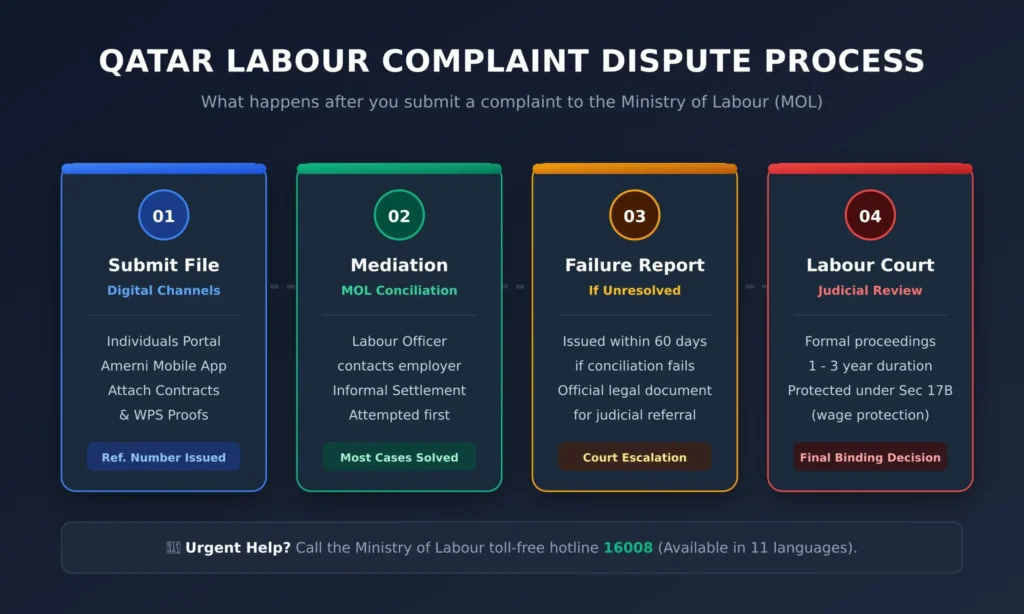
If your salary is late, your contract terms don’t match what’s being paid, or your employer is violating agreed working hours, MOL has a dedicated channel separate from general customer service, and it’s worth understanding the full path a complaint can take, not just how to submit one.
Step 1: Submit your complaint
- Log in to the Individuals Portal via NAS, or open the Amerni app
- Navigate to the Unified Platform for Complaints and Whistleblowers
- Select your complaint category, unpaid wages, termination dispute, and contract violations are the most common
- Attach your verified labour contract and supporting evidence (payslips, WPS records, written communication)
- Submit and keep your reference number to track progress
Step 2: Mediation
Most complaints first go through a conciliation process, where a labour relations officer attempts to settle the matter directly between you and your employer. Many wage disputes are resolved at this stage without ever reaching a courtroom.
Step 3: If mediation fails
If conciliation doesn’t resolve the case, MOL typically issues a Failure Report within 60 days, after which your case can be referred to the Labour Court.
Step 4: Labour Court
Court proceedings can take anywhere from one to three years depending on complexity and appeals. One protection worth knowing here: under Section 17B, wages may continue to be paid during the appeal process in certain cases, so an ongoing court case doesn’t automatically mean an ongoing loss of income.
A few things that noticeably speed the process up at every stage: submitting accurate employer details (name, address, and company registration number), filing promptly rather than waiting weeks after the issue starts, stating the violation specifically (“non-payment of wages for three months” rather than a general complaint), and keeping your own copies of everything you submit.
In addition to physical complaint kiosks at Ministry branches, MOL also runs a free hotline (16008) for urgent matters. It is offered in eleven languages for employees who feel uncomfortable filing digitally.
Who Runs the Ministry of Labour
Qatar’s Minister of Labour is Dr Ali bin Saeed bin Samikh Al Marri, appointed in October 2021 and reappointed by Amiri order in March 2023. Before this role, he chaired Qatar’s National Human Rights Committee, which is part of why the ministry’s 2026 direction leans heavily toward digital enforcement and worker-rights transparency rather than just administrative processing.
Frequently Asked Questions
Is the Ministry of Labour the same as the Ministry of Interior?
No. MOL governs your employment contract, wages, and workplace rights. MOI governs your visa, residency status, and entry into the country. They share data for things like employer changes, but they’re separate authorities with separate portals.
How do I file a labor complaint in Qatar?
Log in to the Individuals Portal through NAS or open the Amerni app, go to the Unified Platform for Complaints and Whistleblowers, select your complaint type, attach your contract and evidence, and submit. Most cases start with mediation before any court involvement.
How do I check my labour contract online?
Through the MOL Individuals Portal’s Labour Contract Verification section, using your QID and NAS login, or the equivalent option in the Amerni app.
How do I contact the Ministry of Labour in Qatar?
The most reliable route for a wage or contract issue is the Individuals Portal or the free 16008 hotline, since both create a trackable case reference. Verify the current address and email directly on MOL’s official website for general inquiries or in-person branch visits, as ministry contact information is periodically updated.
Who is the current Minister of Labour in Qatar?
Dr Ali bin Saeed bin Samikh Al Marri, in the role since October 2021.
Can I switch employers without my current employer’s approval?
Yes. The No-Objection Certificate requirement has been abolished. You can initiate an Employer Change Service request through the Individuals Portal once you meet the eligibility criteria, most commonly having completed any probation period specified in your contract.
Does the minimum wage apply to domestic workers too?
Yes. Qatar’s non-discriminatory minimum wage law, introduced in 2021, explicitly covers domestic workers alongside every other employment category, with the same QAR 1,000 basic salary floor and housing/food allowance structure.
For the official, always-current version of any MOL service, including exact contact details and office locations, verify directly through the Ministry of Labour’s own portal at mol.gov.qa, or the Government Communications Office’s labour reform summary, before acting on time-sensitive matters like a complaint deadline or contract dispute.