
Getting an “Unfit” result on your Qatar visa medical test is understandably stressful. If you’re wondering what happens if Qatar visa medical unfit status gets logged on your file, here’s exactly what it means for your visa and your job. This guide walks through what triggers this status, the most common reasons applicants fail, and what your options are if you get a “Deferred” result rather than a final rejection.
If you’re not sure where your results currently stand, start by checking your Qatar visa medical report status before assuming the worst; a slow update isn’t the same as a failed test.
What Happens If Qatar Visa Medical Unfit?
An “Unfit” result triggers an automatic notification to both the Ministry of Interior and your employer through the Ministry of Labour system. From there:
- Your visa file gets locked. Your QID application is put on hold, and a travel restriction is placed on your profile until the matter is resolved.
- Timelines depend on the reason. For conditions classified as an absolute public health risk, the standard process involves repatriation within 7 to 14 days, with the employer responsible for arranging travel.
- Not every case is final. Conditions that are treatable may result in a “Deferred” status rather than an outright “Unfit” classification, which gives you a path to retest rather than an automatic exit.
Common Reasons Applicants Fail the Medical Test
The Medical Commission applies strict thresholds for public health risks, along with job-specific physical requirements depending on your role.
Infectious disease related:
- Active or old inactive tuberculosis visible on a chest X-ray
- Positive results for HIV, Hepatitis B, or Hepatitis C
- Severe, untreated hypertension
Job-specific requirements:
- Vision or coordination issues for roles involving machinery or transport
- Active skin conditions or gastrointestinal infections for food handling and hospitality roles
It’s worth noting that even an old, fully healed TB scar can trigger a “Deferred” status for further testing, it doesn’t automatically mean rejection, but it does mean more tests before a final decision.
If You’re “Deferred,” Here’s What to Do
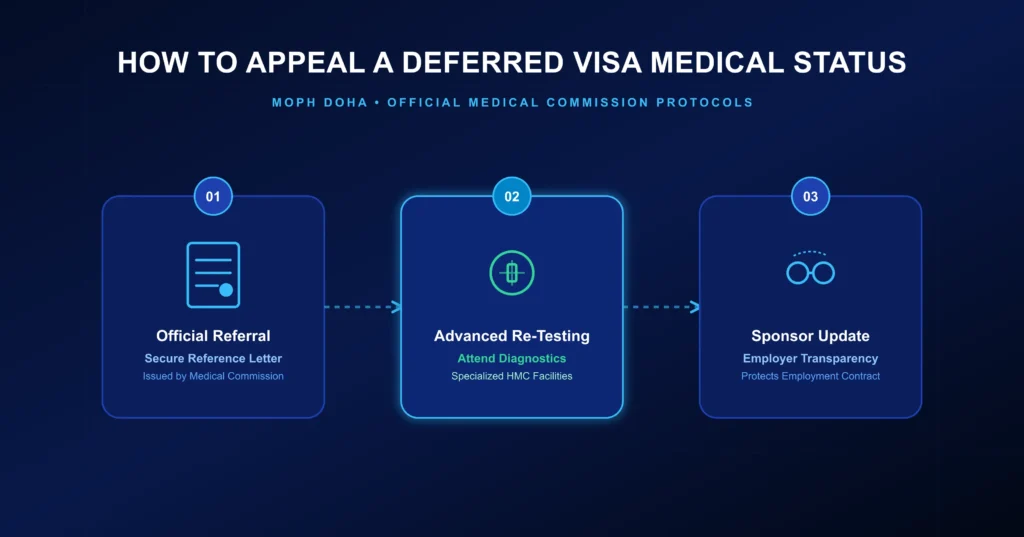
A “Deferred” or “Under Review” result is not the same as “Unfit.” It usually means the Commission wants a second opinion before making a final call.
- Get your referral letter. The Commission will direct you to a facility, typically within the Hamad Medical Corporation (HMC) network, for further testing.
- Attend the retest. This may involve a CT scan, a repeat blood panel, or other targeted tests depending on the original concern.
- Keep your employer informed. Share copies of your deferral paperwork and appointment confirmation with your sponsor so they’re not left guessing about your status. If your visa timeline is affected while this is being sorted, it’s worth understanding how to change a Qatar visa to a work visa so you know your options.
Re-testing typically takes 2 to 4 weeks to produce final results, mostly due to lab processing and review time, so it’s worth planning around that rather than expecting an immediate answer.
What If You Believe the Result Is Wrong?
If you genuinely believe your test result is inaccurate, for example, a mix-up with someone else’s sample or a condition you know you don’t have, you can request a formal second opinion rather than simply accepting the outcome. This is done by asking the Medical Commission (not the referral facility) for a medical review request, which triggers an independent re-evaluation of your original sample and results by a different panel.
This is a separate process from the standard “Deferred” retest, and it’s specifically meant for cases where you’re disputing the finding itself, not just waiting for a treatable condition to clear. Keep a copy of your original test report and any previous medical history that supports your case, as the review panel will want to see it.
Once You Pass: The Hamad Health Card
Once you clear the Medical Commission under the current Qatar visa medical test rules and receive your QID, you become eligible for the Hamad Health Card through the Primary Health Care Corporation (PHCC). This gives you access to subsidized consultations, emergency care, and prescriptions at state-run clinics. You can check your card’s status anytime through our Qatar health card check guide.
Health Card Fees at a Glance
All payments are made electronically, cash is not accepted for health card fees.
Frequently Asked Questions
Can an old, fully healed TB scar still cause an unfit result?
Yes, this is more common than people expect. Any radiological trace of past TB, even fully inactive, typically triggers further testing. Depending on the confirmatory results, some applicants clear the process while others may still face restrictions depending on their role.
Can my employer cancel my contract if I fail the medical test?
Under Qatar labor law, yes. A valid residency permit is a legal condition of employment, so if the Medical Commission declares you unfit, the employer generally isn’t able to proceed with your residency and can end the contract. The employer remains responsible for the medical commission fee already paid and any required repatriation costs.
How long before I get final results after a deferred retest?
Usually around 2 to 4 weeks, depending on lab turnaround and whether additional specialist review is needed.