
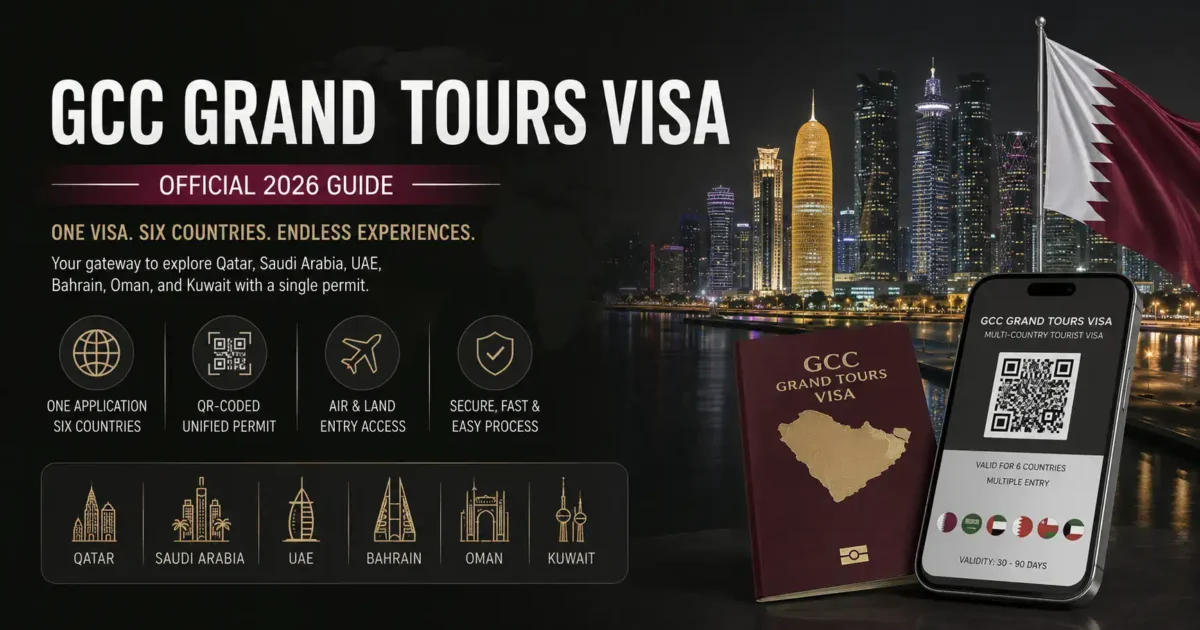
Six countries. One permit. A single Gulf itinerary that doesn’t need six separate embassy files.
That’s the promise behind the GCC Grand Tours Visa, and if Doha is going to be your base for exploring the region, here’s exactly where things stand in 2026, what’s confirmed, and what’s still projection.
What is the GCC Grand Tours Visa?

The GCC Grand Tours Visa is a Schengen-style unified tourist visa built to cover all six Gulf Cooperation Council states:
- Qatar
- Saudi Arabia
- The UAE
- Bahrain
- Oman
- Kuwait
One approval, one QR-coded permit, six borders.
Instead of filing separate applications per country, travelers submit one digital application. Once approved, that single authorization is meant to work at airports and land borders across the bloc.
Why This Matters for Qatar Specifically
For Qatar, this is a real positioning shift. Hamad International Airport (HIA) already ranks among the world’s top-connected hubs. Pair that with a unified regional visa, and Qatar stops being a stopover, it becomes a launch point for a full Gulf circuit.
If you’re flying in soon regardless of the Grand Tours timeline, it’s worth knowing HIA already runs smart gate registration for visitors that speeds up border clearance.
The Two Entry Points Into the Grand Tours Region
- Air entry: via Hamad International Airport, Doha
- Land entry: via the Abu Samra border crossing into Saudi Arabia, which under the unified framework is expected to let Grand Tours visa holders cross by road instead of flying between stops
Unified GCC Visa Apply Online: Phased Portal Launch Dates
Here’s the part most articles get wrong, so let’s be precise.
The GCC Grand Tours Visa has not fully launched yet. As of mid-2026, the bloc is running a phased pilot, not a live public system.
Current Rollout Status
This timeline already slipped once, the original target was late 2025, pushed back so immigration databases across six sovereign states could actually sync, as confirmed by Saudi Arabia’s Tourism Minister at the Gulf Gateway Investment Forum.
On “GCC Grand Tours visa launch date” searches: anyone promising a firm, locked-in date right now is getting ahead of the official record. Treat confident dates with skepticism until GCC interior ministries publish them directly.
How the Application Process Is Expected to Work
Once live, the process is designed to run in three simple steps:
- Log in to the centralized government portal: expected to function similarly to Qatar’s own Hayya visa platform, with one login covering all six countries
- Submit your application and documents: passport, photo, travel plan, and supporting proof in a single digital form
- Receive your QR-coded permit electronically: no embassy visit, no separate approvals per country
A Direct Warning About Fake “Official” Sites
Several third-party sites are already using “GCC Grand Tours visa official website” as bait, collecting passport scans and “processing fees” for a system that isn’t accepting applications yet.
Until an official government domain is announced, don’t submit documents or payments anywhere claiming early access. If you’re ever unsure whether an entry document is genuine, this breakdown on how to check if a Qatar visa is original or fake applies the same verification logic here.
GCC Grand Tours Visa Price, Fees & Validity Tiers
Official pricing hasn’t been finalized or published by GCC governments. What exists are draft fee schedules discussed at ministerial level.
Processing time is targeted at 3–7 business days, with approval delivered electronically.
These figures are working estimates, not confirmed government fees, treat any exact “locked” price quoted online today as a projection. If you want to compare against what Qatar currently charges for its own individual entry visas, our Qatar visa price and official fees matrix tracks the confirmed 2026 rates.
Step-by-Step GCC Grand Tours Visa Requirements
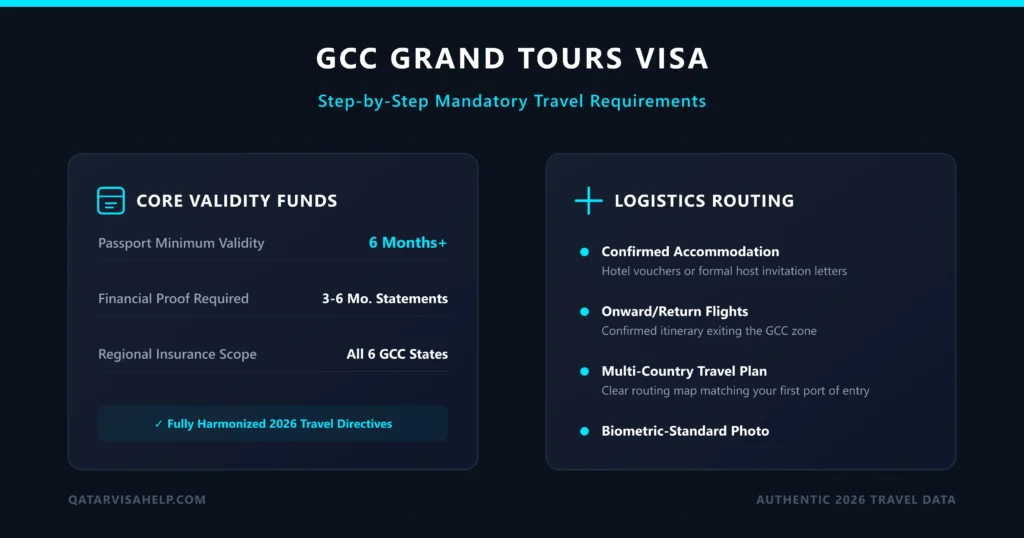
Final documentation rules are still being harmonized, but officials have consistently pointed to this baseline checklist:
- Passport validity of at least 6 months beyond your planned exit from the GCC region
- Regional travel insurance covering medical treatment and repatriation across all six states, similar in structure to the QIC insurance Qatar already requires for its own visas
- Confirmed accommodation bookings for each country on your route, or a formal invitation letter
- Onward or return flight proof, showing exit from the GCC region at the end of your stay
- Recent biometric-standard photo
- Proof of sufficient funds, typically 3–6 months of bank statements (for reference, see how much cash Qatar currently requires for its individual tourist visa)
- A basic multi-country travel plan showing your intended route between the six states
Qatar-specific tip: because Doha is positioned as an entry hub under this framework, expect immigration to weigh your first port of entry documentation heavily, meaning your HIA arrival details should be the cleanest part of your file.
Processing Routes for Global Travelers
Eligibility will likely mirror each country’s existing individual tourist visa rules, at least initially.
GCC Grand Tours from Pakistan: Step-by-Step Outlook
Pakistani nationals represent a significant share of Gulf tourism, so this corridor matters, but there’s a current wrinkle worth knowing before you plan around it.
Step 1: Know the current reality. Qatar’s own visa-on-arrival facility for Pakistani travelers is presently suspended, with all entries routed through the Hayya portal instead. That same digital-first pattern is expected to carry over into how the Grand Tours system handles Pakistani applicants once it launches.
Step 2: Expect the same centralized portal, with possible extra document checks common to current e-visa processing: financial proof, accommodation verification, polio certification.
Step 3: Land in Doha first. HIA is shaping up as a practical entry point, given direct route density from Karachi, Lahore, and Islamabad.
Step 4: Move onward without reapplying. Once cleared through Qatari immigration under the unified permit, onward movement to the other five states wouldn’t require a second application.
For now: continue applying through Qatar’s active Hayya channel for any near-term travel, it remains the only reliable route until Grand Tours goes live.
The same step-by-step logic extends to other high-volume Gulf tourism markets like India, see our guide on Qatar visa on arrival for Indians for the current individual-country process while the unified system is still in pilot.
GCC Grand Tours Update: What to Watch Next
- UAE–Bahrain pilot results: this corridor is the proving ground shaping the Q4 2026 pilot design
- Qatar’s own confirmation timeline: Qatar is described as central to the plan given HIA’s hub role, but hasn’t yet published its own pilot participation date
- Fee schedule finalization: expected closer to Q3 2026, ahead of the pilot window
- Smart gate and biometric rollout: Doha, Dubai, and Riyadh are already upgrading infrastructure to read unified QR permits, alongside existing programs like MOI biometric enrollment for visitors in Qatar
Frequently Asked Questions
What is the GCC Grand Tours visa?
A proposed Schengen-style unified tourist visa allowing one application and one permit to grant entry across all six GCC states: Qatar, Saudi Arabia, the UAE, Bahrain, Oman, and Kuwait. It’s currently in a pilot phase, not yet fully operational.
What are the 6 countries covered by GCC visa?
Qatar, Saudi Arabia, the United Arab Emirates, Bahrain, Oman, and Kuwait.
Which GCC residents are visa free?
GCC nationals, citizens of the six member states, already travel freely between each other’s countries using only their national ID cards. The Grand Tours visa extends that same ease to international tourists and long-term expatriate residents, who currently still need individual visas per country.
Can expats currently living in Qatar use the Grand Tours visa for regional trips?
Not yet, the system isn’t live. Once it launches, long-term Qatar residents are expected to benefit significantly. Until then, expats should keep tracking their existing residency status through channels like MOI visa extension fees or current entry suspension updates before assuming Grand Tours changes anything about their present sponsorship rules.
Is there an official website live right now?
No. No GCC government has published a live application portal as of mid-2026. Treat any site claiming to be the “official portal” or offering paid pre-registration as unverified. If you need visa help in the meantime for actual Qatar travel, working through a verified Qatar visa agent is safer than gambling on an unconfirmed Grand Tours listing.
Note: This guide reflects the most current publicly available information as of mid-2026. Because the GCC Grand Tours visa is still in pre-launch and pilot stages, requirements, pricing, and timelines remain subject to change by GCC member governments. Always verify final details against Qatar’s official immigration channels before booking travel around this visa.