
If you’re an expatriate working in Qatar and planning to bring your spouse, children, or parents to live with you permanently, the Qatar Family Residence Visa 2026 is the pathway you need, not the short-term visit visa most people search for first. This guide breaks down the current eligibility criteria, the exact salary thresholds enforced through the Wage Protection System, and the full post-arrival process that leads to a Qatar ID (QID) for each dependent.
Unlike a visit visa, which expires after a few months, the Qatar Family Residence Visa 2026 grants your dependents full resident status for as long as your employment and sponsor eligibility remain valid, including access to public healthcare, school enrollment, and the ability to sponsor domestic help under certain conditions.
What Sets the Family Residence Visa Apart in 2026
The Ministry of Interior draws a hard line between a Family Visit Visa and a Family Residence Visa, and confusing the two is one of the most common reasons applications stall. A visit visa is capped at a handful of months and issues no QID. The Qatar Family Residence Visa 2026, by contrast, is designed for genuine long-term relocation; it results in a Qatar ID, ties your dependents into the national health and education systems, and remains valid on an annual renewal cycle tied to your own residency.
If your family member is currently in Qatar on a visit basis and you’re weighing whether to convert, it’s worth first reviewing the Qatar family visit visa requirements to confirm Before beginning a residency application, find out which track your dependent is actually on.
Salary and Profession Eligibility for 2026
The MOI enforces strict, automated eligibility checks tied directly to your employment contract and your monthly WPS-verified salary:
- Government and semi-government employees: A minimum basic salary of QAR 10,000 per month, or QAR 6,000 with verified employer-provided family housing.
- Private sector employees: The same QAR 10,000 / QAR 6,000 (with housing) structure applies, but your profession must be classified as technical, specialized, or non-labour on your Qatar ID.
- Excluded categories: General labourers, drivers, domestic staff, and similar labour-classified professions are not eligible to sponsor family residency, regardless of salary.
Your declared salary must match what is actually transferred through the Wage Protection System every month. A mismatch between your contract figure and your real WPS transfers is one of the fastest ways to trigger an automatic rejection.
Step-by-Step Family Residence Visa Process
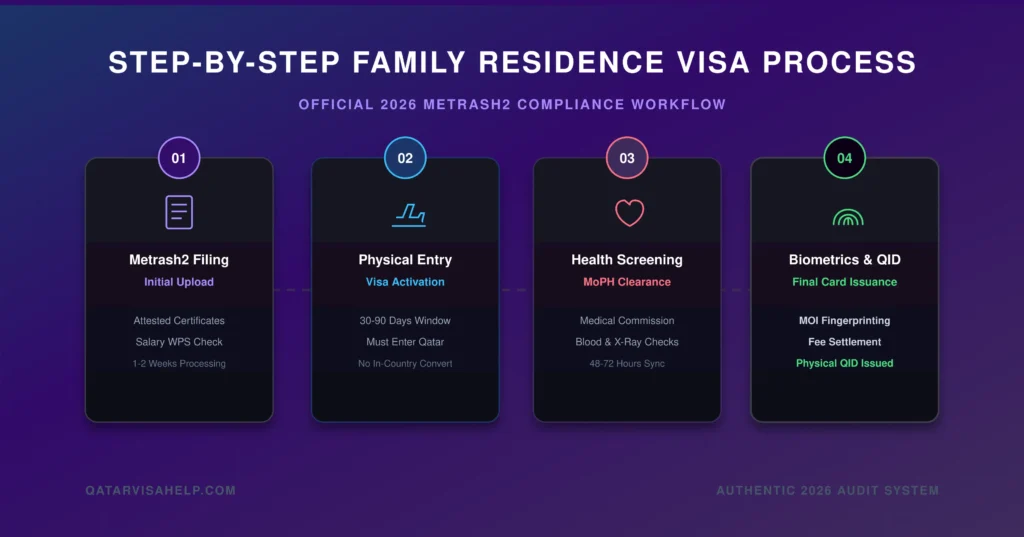
- Confirm eligibility. Verify your profession classification and salary meet the thresholds above before spending money on document attestation.
- Gather and attest documents. This includes the sponsor’s Qatar ID, the dependent’s passport, an attested marriage certificate (for a spouse) or birth certificate (for children), and proof of suitable family accommodation, either a tenancy contract or employer housing letter.
- Submit via Metrash. Log in to the Metrash app, navigate to Visa → Issue Visa → Family Residence Visa (not Family Visit), and upload each dependent’s details exactly as they appear on their passport.
- Pay the application fee and wait for initial approval, typically within one to two weeks for complete files.
- Travel within the validity window. Once approved, an entry visa is issued for each dependent, valid for a limited window, usually 30 to 90 days within which they must physically enter Qatar.
- Complete the medical exam. Every family member must attend an MOI-approved Medical Commission center for a health screening before a QID can be issued.
- Complete biometric enrollment. All dependents aged 18 and above must visit an MOI fingerprinting center for biometric registration, including fingerprints, palm scan, and facial capture, see our MOI biometric enrollment guide for what to expect at the appointment.
- Pay Residency Permit and QID fees and collect the physical Qatar ID cards from the designated MOI office.
Qatar Family Residence Visa 2026: Fee & Requirement Summary
What Happens After the QID Is Issued
Once your dependents hold an active Qatar ID, a few practical steps follow almost immediately. Children between 6 and 18 years old must be registered with the Ministry of Education and Higher Education, this becomes mandatory at renewal time, not just at initial issuance. Health coverage also needs to be arranged promptly; while employer-sponsored insurance typically covers a spouse and up to a limited number of children, additional dependents such as parents usually require a separate policy see QIC Insurance Qatar 2026 for compliant options that satisfy MOI renewal checks.
If your family’s long-term plans extend beyond a standard residence permit, it’s also worth understanding how a family residence history factors into broader status changes. Our guide on Qatar permanent residency benefits covers the criteria for longer-term settlement options.
Common Reasons Family Residence Applications Get Rejected or Delayed
- Salary reported on paper doesn’t match WPS records: even a temporary discrepancy is flagged automatically.
- Unattested marriage or birth certificates: attestation from both the issuing country’s foreign ministry and the Qatari embassy is mandatory for residence visas, unlike some visit visa cases where this requirement is relaxed.
- Housing documentation gaps: an unregistered tenancy contract or missing municipality approval is a frequent, avoidable delay.
- Missed medical or biometric appointments: approval doesn’t guarantee a QID; skipping either mandatory step post-arrival halts the process indefinitely.
If your case involves an employment transition rather than a straightforward family sponsorship, review how to change a Qatar visa to a work visa, since a pending status change on the sponsor’s side can also stall a dependent’s residence application. For appointment-related delays specifically, our Qatar Visa Center appointments guide covers how to book and track biometric or medical slots directly.
Frequently Asked Questions (FAQs)
Can I convert my family member’s visit visa into a residence visa while they’re already inside Qatar?
No. The MOI does not permit in-country conversion. The dependent must exit Qatar, have the residence entry visa issued, and re-enter under that new visa before the QID process can begin.
Is there an age limit for children under a Family Residence Visa?
Children can generally be sponsored under a residence visa up to age 21, after which they typically need their own independent visa category, such as a work or study visa.
Do working spouses need a separate income requirement to sponsor a husband?
Female professionals working in recognized fields such as healthcare, education, engineering, or finance can sponsor a spouse under the same salary and housing criteria that apply to male sponsors, along with a minimum Qatar residency period.
How long does the full process take from application to receiving the QID?
Initial approval typically takes one to two weeks for complete files, followed by the entry window, medical exam, and biometric steps; most sponsors should budget four to eight weeks total from submission to a physical QID in hand.